
I began with good intentions. I started with a rule. Code that touches an invariant — something that must never break — gets reviewed, always. Code that doesn't gets to pass on tests alone, as long as I pressure-test that the tests are complete. A reasonable rule. I held it for a while.
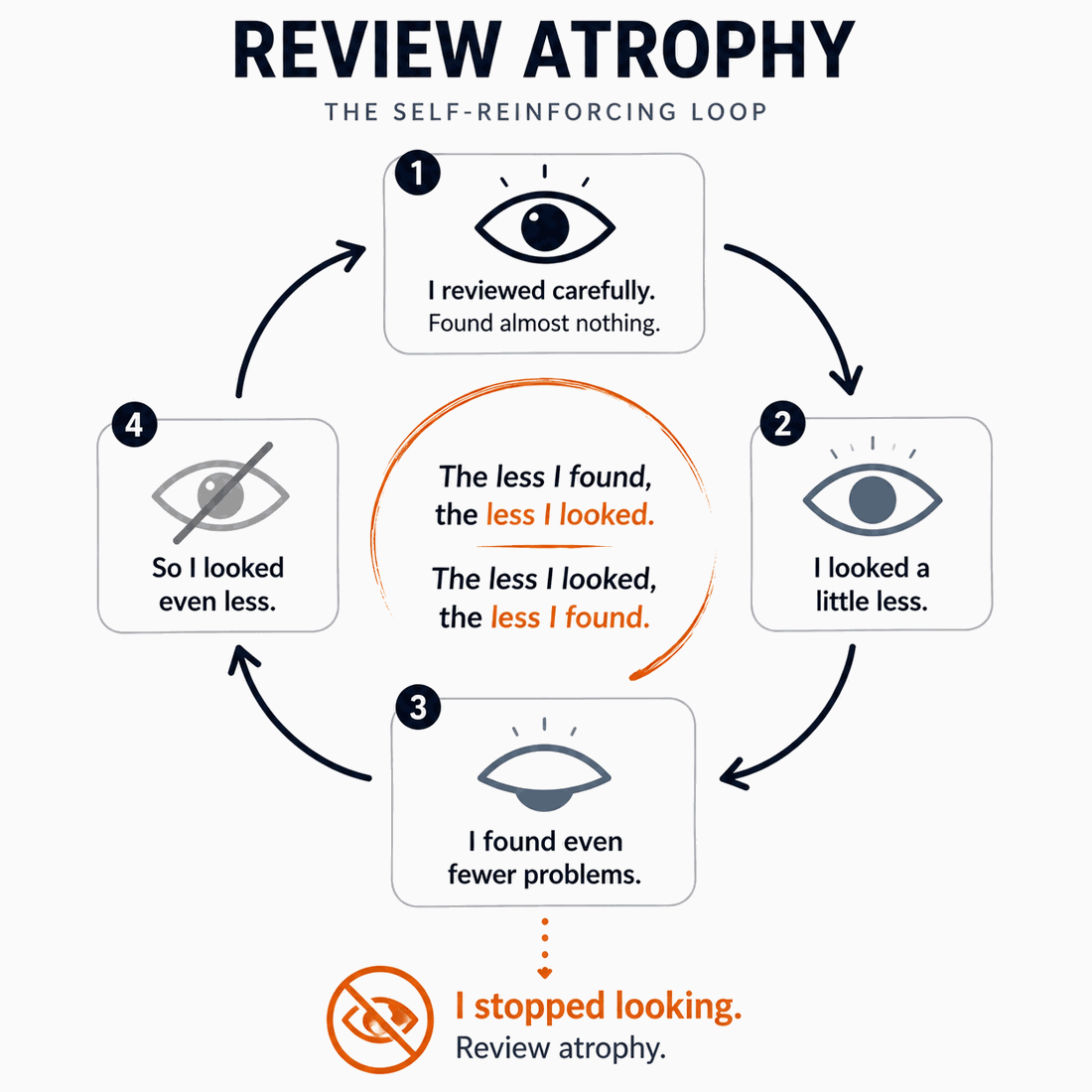
Then the AI's code kept looking right. You review carefully and find almost nothing. Next time you look a little less hard, because there's a feature waiting and the last ten reviews turned up nothing. You find even less. That seems to confirm the review wasn't worth the time. So you look less again.
The pattern
The discipline wasn't overruled. It was starved.
The less I found, the less I looked. The less I looked, the less I found. Eventually I wasn't reviewing at all.
Good AI doesn't eliminate bugs. It changes the distribution of bugs. The ones that survive are the rare, expensive ones near the invariants — the exact thing review was there to catch. So when review goes, those are precisely the bugs that slip through.
I don't think I have less or more discipline than the average developer. The forces that did this to me aren't personal, so I don't see why they'd stop at me.
Discipline isn't the variable anyway. Human review just can't keep pace with machine generation. The gap doesn't sit still. It trains you out of looking. We are losing the review muscle en masse.
Maybe the low-frequency, high-cost bug is just the new cost of doing business — and the cost is accruing without anyone deciding to take it on, or knowing how much.
Next step
Not sure your team is still really reviewing what ships?
The AI Trust Assessment gives you an evidence-based read on where your review discipline has actually held — and where it's quietly eroded.